
Kari: The Man Who Gave Indian Motorsport Its Shape
From Coimbatore workshops and Sholavaram airstrips to Formula Maruti, Super Speeds and Kari Motor Speedway, Kari built the machinery and the confidence for a generation of Indian racers.
Created using advanced editorial technology. Reviewed and approved by ViPeople.
- Born
- 20 June 1954 · Coimbatore
- School
- Stanes Anglo-Indian Higher Secondary School
- Team and workshop
- Super Speeds
- Best-known creation
- Formula Maruti
- Circuit legacy
- Kari Motor Speedway
- Died
- 24 August 1995
From the old airstrip at Sholavaram to the Himalayan Rally, from Super Speeds and Formula Maruti to the circuit that carries his name, Sundaram Karivardhan helped create the foundations of modern Indian motorsport.
Known almost everywhere simply as Kari, Sundaram Karivardhan was a racing driver, engineer, constructor, team owner and businessman. He designed cars, prepared engines, built teams, supported drivers and raced whenever the opportunity arose. His interests reached from Premier Padminis and Maruti Gypsies to Formula Atlantic cars, rally specials, aircraft and permanent racing circuits.
Kari understood cars as complete machines. The engine mattered, as did the suspension, tyres, bodywork, driver, route and people working around the car. He could discuss an engine’s breathing, sketch a livery, examine a suspension component and then climb into the cockpit himself.
That combination made him one of the most influential figures in Indian motorsport.
A Coimbatore beginning
Kari was born in Coimbatore on 20 June 1954 into the Lakshmi Mills family. His father, G. K. Sundaram, and his uncles, G. K. Devarajulu and G. K. Rajagopal, came from a family with deep connections to industry, engineering and machinery. R. Gopinath, the son of G. K. Rajagopal, later became a prominent name in Indian racing and rallying.
Kari was educated at Stanes Anglo-Indian Higher Secondary School in Coimbatore. The city provided a natural setting for his interests. Coimbatore was already known for textiles, precision engineering and workshops where practical knowledge passed from one generation to the next.
Kari carried that practical spirit towards speed.
He travelled widely while still young and attended the Jim Russell Racing School. His time abroad introduced him to a developed motorsport culture, where teams operated with specialist engineers, testing programmes, dedicated suppliers and carefully designed racing machinery.
Family and period paddock accounts recall his contact with leading figures from the international racing world, including Frank Williams, Jack Brabham, Bruce McLaren, Enzo Ferrari and Gordon Murray. Kari was fascinated by the way international teams designed their cars and organised their operations. He studied those methods closely and explored ways of bringing engineering knowledge, equipment and licensed technology into India.
He was also drawn to the engineering ideas associated with Colin Chapman and Carroll Shelby. Chapman’s pursuit of lightness and Shelby’s combination of power, design and competition discipline resonated with Kari’s own approach. His later work on projects connected with the Lotus 7, AC Cobra and Ford GT40 reflected that international outlook.
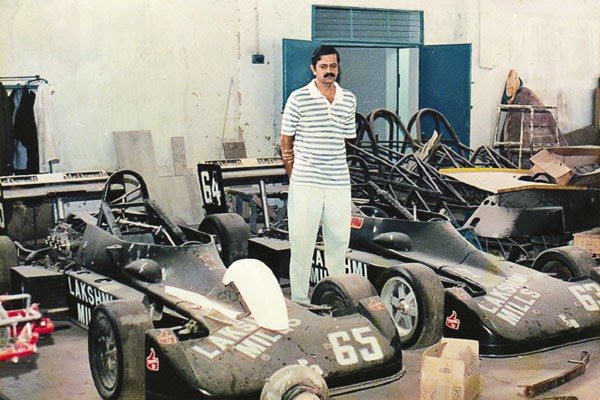
Kari was among the early Indian motorsport figures to be interviewed by BBC London. The BBC team travelled to India and filmed him inside his Lakshmi Mills workshop in Coimbatore, surrounded by the cars, engines and machinery that had shaped his career.
The country had drivers, spectators and enthusiasm in abundance. Kari helped give them machinery capable of matching it.
Sholavaram at full volume
Before permanent circuits were built, Indian motor racing belonged to Sholavaram.
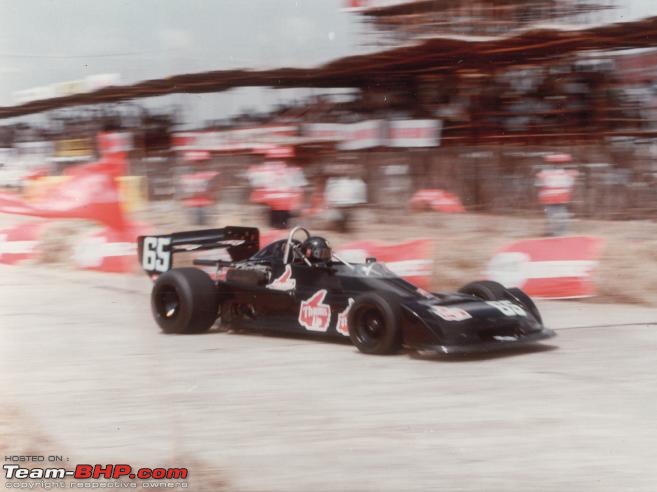
The old airstrip north of Madras became the centre of the racing calendar for several decades. On race weekends, thousands of people arrived by car, bus and train. Families came with picnic baskets, enthusiasts carried tools and spare parts, and competitors arrived with cars prepared in ordinary workshops with extraordinary imagination.
The venue had temporary pits, bamboo fencing, hay bales and a racing surface originally designed for aircraft. It was wide, fast and rough. Long straights led into heavy braking zones, while the runway allowed cars and motorcycles to reach remarkable speeds.
The All India Motor Race Meet became one of the largest sporting gatherings in the country. Crowds of around 30,000 people were recorded, and the event attracted an extraordinary mixture of machinery.
There were Premier Padminis, Fiats, Ambassadors, Sipani Dolphins, Datsuns and heavily modified Indian saloons. There were Formula Ford, Formula 3, Formula Atlantic and Formula 5000 cars. There were Ferraris, Mercedes, Jaguars, American specials and motorcycles from across India.
Vicky Chandhok competed in Formula 2 cars capable of around 250 kilometres per hour. Vijay Mallya appeared with a former Ensign Formula One car, the Ensign N177, chassis MN08, powered by a three-litre Ford Cosworth V8. He raced the car in the open class at Sholavaram, bringing a genuine Formula One machine into one of India’s most colourful racing environments.
Maharaj Kumar Ghanadityasinhji of Gondal raced a Surtees TS11 Formula 5000, powered by a large Chevrolet V8 producing power in the region of 500 bhp in period specification. The Surtees won the All India Grand Prix at Sholavaram in 1978 and 1979.
Ajit Thomas raced a Chevron Formula 3 car. Tiff Needell and Jim Crawford competed in the Indian racing scene. Indu Chandhok helped develop the organisational structure around the Madras Motor Sports Club. Nazir Hoosein, Anil Bhatia and others gave Indian motorsport a stronger national and international identity.
The Coimbatore connection was equally important. B. Vijay Kumar, Vidya Prakash, V. C. Shrikant, Bobby Jayaram, also known as Pratap Jayaram, Kamlesh Patel and Mustafa Shaik Zackaria were among the drivers, tuners, mechanics and builders associated with the wider racing community of the period.
Competitors were expected to understand the whole car and often took part in its preparation as closely as they took part in driving it.
The paddock was intensely competitive and remarkably open. A problem that appeared on one car could attract advice from rival teams within minutes. Drivers shared information, mechanics exchanged ideas and everybody understood that the next race might depend on a solution discovered in somebody else’s pit.
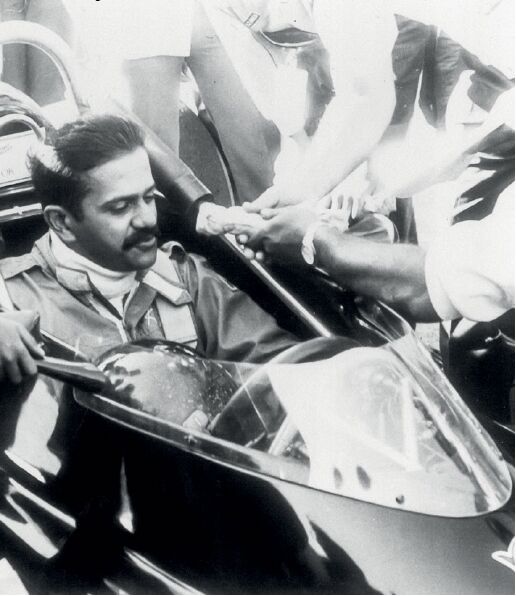
Kari was completely at home there. He built the cars and drove them with exceptional ability, winning across different categories, cars and surfaces. Had he pursued an international driving career, he might have achieved a great deal abroad. He chose to invest that ability in India and help take Indian racing and rallying towards the global stage.
Super Speeds
Kari’s early work developed through P&B Engineering and Super Speeds. The company became his workshop, racing team and engineering base, and later one of the most important constructors in Indian motorsport.
Super Speeds cars were closely associated with Lakshmi Mills sponsorship. The early cars appeared in white and blue before the colour scheme evolved towards black and gold. Kari cared about presentation as much as performance. The liveries and bodywork gave his cars a distinctive identity before they reached the track.
His cars looked as though they had been designed by somebody who understood racing and enjoyed it.
The workshop prepared Premier Padminis, Maruti 800s, Maruti Gypsies, Sipani Dolphins, Ambassadors, Datsuns and several racing specials. The work covered circuit racing and rallying, which demanded two very different approaches to preparation.
A circuit car needed speed, braking performance and balance. A rally car needed to survive distance, heat, dust, mud, rough roads and long periods between service points. Many of India’s major rallies ran for 2,500 kilometres or more. The Himalayan Rally extended across some of the toughest terrain in the country, with routes remembered as journeys of more than 5,000 kilometres.
Kari understood reliability as a form of speed.
His workshop developed rally cars for long Indian events, including Maruti 800s, Gypsies, Padminis and Ford Escorts. Kari’s Ford Escort preparations remain part of the Coimbatore rallying memory, especially among the people who worked around the cars and followed the major events of the period.
His approach was practical and inventive. Components had to be strong, serviceable and available. Cooling systems had to work in extreme heat. Suspension systems had to absorb repeated impacts. Engines needed useful power while retaining the durability required for long-distance rallying.
The Himalayan Rally
The Himalayan Rally, founded by Nazir Hoosein in 1980, brought a different scale of competition to India.
Running through the 1980s and continuing until 1990, it became the country’s most ambitious international motorsport event. The rally covered vast distances and included mountain roads, forests, broken surfaces, high-altitude sections and rapidly changing weather.
It attracted Indian competitors, international drivers, overseas teams and machinery that had previously been seen mainly in European competition.
The event’s history includes Ford Escorts, Fiat 131s, Lancia Deltas, Audi Quattros, Mercedes machinery and the extraordinary Ford RS200. The RS200 was one of the defining Group B cars of the period, with a mid-mounted engine, four-wheel drive and extraordinary acceleration.
A Ford RS200 appeared in the 1986 Himalayan Rally with Stig Andervang. For Indian spectators and competitors, seeing a car of that level tackle the mountain route was a major moment. The event gave people in India the chance to see international rally technology operating in conditions entirely different from European stages.
Factory-backed and works-supported operations also formed part of the Himalayan Rally story. European manufacturers brought cars, technicians and support personnel into an Indian event that demanded a different kind of preparation.
Nazir Hoosein provided the vision and organisation. The Indian engineering community provided the local knowledge and technical support required to make the event work. Kari was among the people who helped connect those two worlds.
Foreign drivers and visiting crews often relied on Indian specialists for preparation, route knowledge, technical advice and service support. Kari’s workshop was one of the places where that support could be found.
The result was an international rally with an Indian character. It carried the prestige of a global event and demanded the resilience of an endurance contest.
The people around Kari
Kari’s importance came partly from his own driving and engineering. His wider influence came through the people he trained, encouraged and gave opportunities to.
J. Anand worked closely with Kari at a young age and learned the preparation, tuning and engineering side of the sport through Super Speeds. He later established his own successful operation and continued the technical tradition that had begun in Coimbatore.
N. Leelakrishnan also developed his skills around Kari’s workshop. He went on to become one of India’s most successful tuners and rally figures, working with MRF and later with several leading teams and drivers.
That movement of knowledge became central to Indian motorsport. A driver could enter through Formula Maruti, learn from a tuner, move into rallying or Formula 3 and eventually establish a team or workshop of his own.
Kari encouraged that process.
He also helped drivers who arrived with ambition and limited resources. Hari Singh’s association with Kari is one of the best-known examples. After seeing Hari compete in a Gypsy, Kari helped rebuild the car, took an interest in his development and supported his progress. Hari later became one of the most successful rally drivers in India.
Narain Karthikeyan, Karun Chandhok, Armaan Ebrahim, Akbar Ebrahim, R. Gopinath and many others came through the racing structure Kari helped create.
The same influence reached the rally paddock, where drivers, navigators, mechanics and engineers benefited from the standards established by Super Speeds.
From Formula Maruti to the world stage
The people who passed through that structure carried its lessons into the next era. Narain Karthikeyan went on to become India’s first Formula One driver, bringing the country’s racing story into the world championship. His journey from Indian single-seaters to Formula One showed what the kind of foundation Kari had imagined could make possible.
Film star Ajith Kumar was also part of the culture around Sholavaram. He went to watch races at the airstrip and drove a Formula Maruti car, connecting the excitement of that earlier paddock with his later work through Ajith Kumar Racing.
Ajith Kumar Racing has continued that connection through people from the same wider racing family, including Narain Karthikeyan, J. Anand, Aditya Patel and Karun Chandhok. Indian motorsport grows through championships and through relationships that continue across generations.
MRF, JK Tyre and the professional era
The growth of Indian motorsport was closely linked to the companies that supported it.
MRF became a major force in rallying and circuit racing. J. Anand and N. Leelakrishnan moved into MRF programmes after their early years around Super Speeds. Their success helped establish the idea that Indian teams could develop serious technical expertise and build programmes capable of competing at the highest domestic level.
Kari later launched the JK Rally Team in the early 1990s. Hari Singh became the principal driver, and the programme produced major championship success. The team raised the standard of Indian rally preparation and created a more professional structure around testing, servicing, fuel injection and driver development.
Thums Up was also associated with Indian motorsport during the Sholavaram period, supporting drivers and racing activity while corporate sponsorship was developing. Lakshmi Mills remained closely connected with Kari and Super Speeds, while MRF and JK Tyre became two of the most important forces in the country’s later racing and rallying scene.
Kari understood the value of that relationship. Sponsorship gave teams the ability to build cars, test properly, travel to events and support drivers over an entire season.
That is how a sport becomes sustainable.
The Maruti connection and Formula Maruti
Kari’s work sat within the early story of Maruti in India.
His interest in affordable, locally supported machinery developed as the Indian car industry began to change. Family and period accounts associate him with the wider industrial and political discussions around Sanjay Gandhi and the arrival of Maruti Suzuki.
Kari understood that the future of Indian motorsport needed accessible cars and locally available components. The Maruti 800 offered the basis for a low-cost racing formula, provided somebody could turn its mechanical parts into a proper competition car.
Kari did exactly that.
During the 1980s, single-seater racing in India demanded serious financial support. Cars, parts and technical assistance were often imported, and young drivers needed considerable backing before they could begin.
Working with Maruti, Kari designed a lightweight single-seater using Maruti 800 engines and mechanical components. He created the spaceframe, developed the design and personally guaranteed the construction of 28 cars.
The cars were launched at the Taj Hotel in Madras in 1987. The entire project was built around a clear principle: Indian drivers deserved a reliable and affordable route into racing.
Formula Maruti provided close competition and a proper racing education. Drivers learned braking, overtaking, racecraft, set-up and discipline in cars that rewarded skill and invited ambition.
The category became a school for Indian motorsport.
Akbar Ebrahim won the inaugural Formula Maruti race. Narain Karthikeyan, Karun Chandhok, Armaan Ebrahim, R. Gopinath, J. Anand, Kamlesh Patel and many others either raced Formula Maruti cars or developed through the structure Kari created.
The cars remained competitive for many years. Later Formula LGB machinery continued the same philosophy through the Super Speeds and LGB engineering connection.
Kari created an entry point into the sport that opened racing to a new generation of Indian drivers.
The circuit, the aircraft and the imagination
Kari’s interests extended beyond cars.
He worked on microlight aircraft and power gliders, using motorcycle and Rotax engines. The runway associated with those aircraft eventually became the basis of Kari Motor Speedway at Chettipalayam in Coimbatore.
The circuit opened in 2003 and became one of India’s most important permanent venues. It gave the country a proper home for national racing, manufacturer programmes, testing and driver development.
The track carries Kari’s name because it represents the same combination of imagination and practicality that defined his life. A piece of land associated with aviation became a racing circuit. A family industrial background became a career in motorsport. A Maruti 800 engine became the basis of a national single-seater category.
Kari moved quickly from one idea to the next. A Formula Atlantic chassis could lead to a rally project. A rally project could lead to a new engine system. A fascination with aircraft could eventually produce a circuit.
He also developed plans for replicas of the AC Cobra, Ford GT40 and Lotus 7. He was interested in the complete automotive world, from high-performance racing cars to road-going sports cars and aircraft.
24 August 1995
On 24 August 1995, Kari died in a flying accident near Coimbatore. He was 41.
The news travelled through Indian motorsport with extraordinary speed. Drivers, mechanics, engineers, team owners and friends gathered to pay their respects. The funeral procession moved through the city as traffic stopped and people stepped aside.
For many who knew him, Kari had been the person they called when a car needed help, when a part needed improving, when a driver needed encouragement or when a difficult engineering problem required one more attempt.
His death left a profound gap in Indian motorsport.
The human stories surrounding him have survived alongside the technical achievements. During one rally, when competitors became stranded late at night after a mechanical failure, Kari spent hours searching for them in his Volvo. The following morning, the stranded crew found beer bottles placed along the route with handwritten notes explaining that Kari had tried to find them.
It was exactly the sort of story people tell about him. There was engineering seriousness when the car needed it, and there was always room for a laugh afterwards.
His work continued through the people he had trained and supported. J. Anand developed his own engineering legacy. N. Leelakrishnan became one of the country’s most respected tuners. B. Vijay Kumar and Super Speeds continued building racing machinery. Narain Karthikeyan and other drivers carried the lessons of Formula Maruti into international competition.
The cars changed. The tyres changed. The circuits became more permanent. Racing became more professional.
Indian drivers continued to find the machinery, competition and opportunity Kari had spent his life building towards.
The lasting legacy
Kari’s influence reaches across almost every part of Indian motorsport.
It is present in the old photographs from Sholavaram, where Formula cars, specials, motorcycles and saloons shared the same runway. It is present in the Himalayan Rally, where Indian crews competed alongside international machinery and Group B technology. It is present in MRF and JK Tyre programmes, in the work of J. Anand and N. Leelakrishnan, and in the careers of drivers who first learned their craft in Formula Maruti.
It is present in the name of the circuit at Chettipalayam.
It is also present in the workshops of Coimbatore, where the work still begins with a car, a problem and somebody willing to stay late until the answer appears.
Sundaram Karivardhan gave Indian motorsport a sense of possibility. He showed that serious cars could be designed and built in Coimbatore, that Indian teams could support international competitors, that Indian engineers could develop championship-winning machinery and that a young driver could be given a genuine path into racing.
His career lasted just over two decades.
Its influence has lasted far longer.
Kari helped give Indian motorsport its shape, its sound and, for many young drivers, its first real opportunity.