Dakar 2027 Opens in Portugal and Crosses Morocco to Marrakech
The 49th Dakar Rally will begin in the Algarve and finish in Marrakech after a 7,824 kilometre journey through Portugal and Morocco. The published route has 4,341 kilometres of timed special stage, a prologue, 12 stages and an Agadir rest day. One detail matters for every calendar: the dates remain subject to FIA World Motor Sport Council approval.
ViPeople Editorial DeskPublished 10 min read
Photograph: A.S.O.
Audio articleListen to this storySerena (Enhanced) · English UK
The next Dakar starts beside the Atlantic and ends in Marrakech. Between 9 and 23 January 2027, the 49th edition is scheduled to move from Loulé and Faro in Portugal into Morocco, with 7,824 kilometres on the route and 4,341 against the clock. The announcement gives teams a new map to work from and restores the rally to Africa for the first time since 2007.
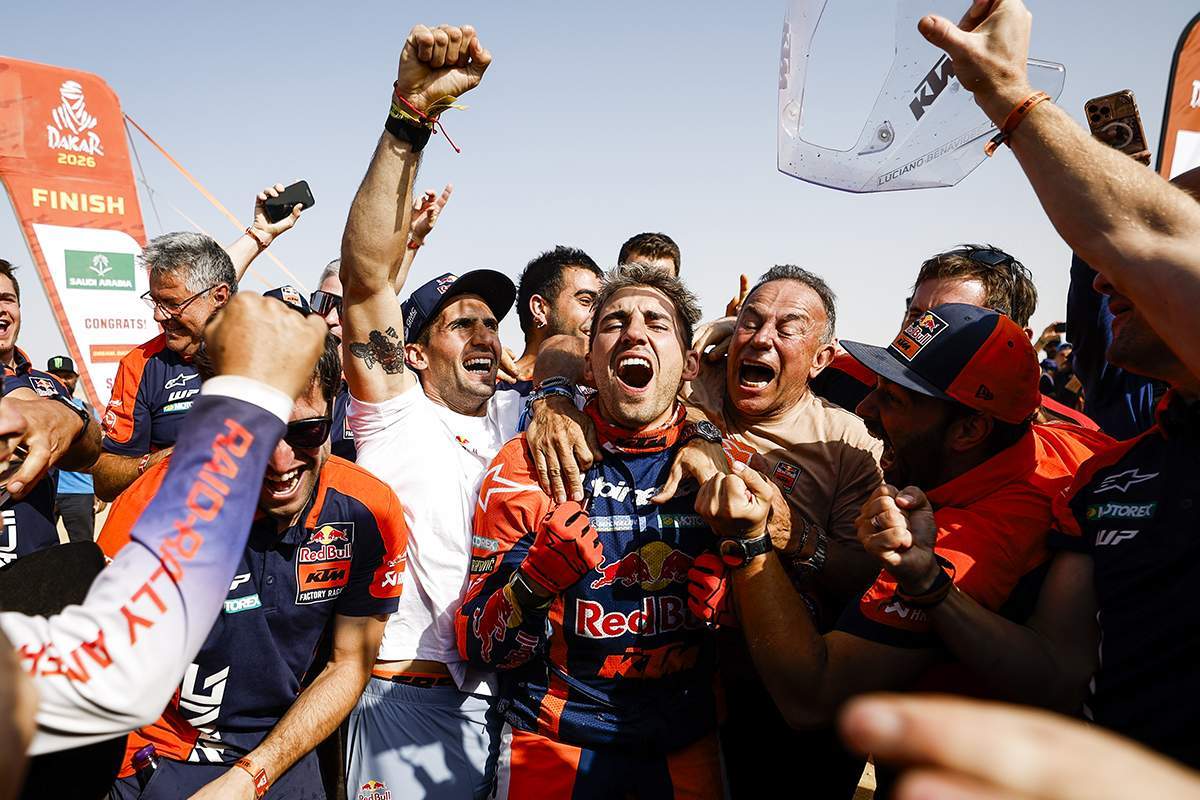
A competitor and the Red Bull KTM team celebrate at the finish of Dakar 2026 in Yanbu. This archive photograph shows the previous edition, the 2027 route moves to Portugal and Morocco.Photograph: A.S.O.
The published plan contains a prologue and 12 stages, six bivouacs and a rest day in Agadir. The dates remain subject to approval by the FIA World Motor Sport Council. That condition belongs alongside every calendar listing and itinerary: the organisers have set out the route and schedule, while final approval is still due.
The change from the original Saudi Arabian plan is substantial. Dakar had been expected to return to the Kingdom in 2027 before the 50th edition in 2028. The 2027 rally will instead draw on Portugal’s experience with rally-raid and Morocco’s long relationship with the event. For competitors, that means a different set of terrain, logistics and navigation questions. For the rally itself, it creates a two-country route with a clear physical transition.
A short opening before the first long transfer
Loulé and Faro host the opening activity. The service park is scheduled to open on 5 January, with administrative and technical checks from 6 to 8 January. The prologue follows on 9 January, then Stage 1 takes place in the Algarve on 10 January. Its 100 timed kilometres sit inside a 300 kilometre day, giving the field an opening test before the route expands.
The first stage is a modest distance beside the Moroccan specials, yet it has real consequence. The prologue and opening kilometres establish competitive order and give each crew an early reading of the conditions. A measured start can protect a vehicle and a rider. A fast one can create a useful position. Teams have to balance both before they have a week of results to understand.
After Stage 1, the competitors travel to the port for an overnight crossing to Nador. On 11 January, a transfer takes the event to its first Moroccan bivouac at Bouarfa. The sea crossing is one of the route’s defining passages. It separates the European opening from the longer desert and mountain work that follows, while adding its own practical demands to the movement of the race.
ViPeople-supplied route illustration for Dakar 2027. The route and stage dates in our report follow the official ASO schedule.Photograph: ViPeople supplied route illustration
The published schedule shows the scale of the daily routine as clearly as the map. Stage 2 is listed at 390 timed kilometres inside a 490 kilometre day. Stage 3 stretches to 410 timed kilometres, while Stage 4 carries 490 timed kilometres on the route from Bouarfa to Zagora. Those figures describe a long working day for everyone in the event. Competitors have to manage the timed section. Their support teams have to move between bivouacs and prepare for arrivals.
The distinction between special and total distance matters to anyone following the rally. The special is where classification time is earned. The total also includes the links that connect a start, a finish and the bivouac. Those transfers still demand attention, fuel and time. A route can look compact on a map while asking a crew to spend a large part of the day moving between places. The published table gives readers a practical way to understand that scale.
Bouarfa is the first Moroccan bivouac in the announced outline, reached after the sea crossing from Portugal. From there the route moves through Zagora and Agadir. The sequence places the competitors in Morocco quickly, then gives them a succession of long specials before the rest day. Later bulletins will supply the road-book detail, but the broad geography already tells teams where logistics and mechanical planning will carry unusual weight.
The Moroccan stages build towards Agadir
Stages 2 to 6 carry the rally through the first sustained block in Morocco. The route goes from Bouarfa towards Zagora and then Agadir. The published special distances range from 365 to 490 kilometres across those days. The longest total day in that section is the 760 kilometre run from Zagora to Agadir, where the special alone is listed at 365 kilometres.
That combination of competition and transfer distance is central to rally-raid. A special may be measured in hundreds of kilometres, while the total day includes the road needed to connect the route with the bivouac. Drivers and riders have to protect concentration through both. Support crews face their own timetable, moving equipment and preparing the next service while the competitors are still on stage.
The organisers describe varied terrain and desert conditions, with most specials expected to sit between 350 and 500 kilometres. Road books and later bulletins will provide the details that turn this broad outline into daily navigation. For now, the route gives teams enough information to begin planning fuel, tyres, parts and staffing, while leaving the stage-by-stage character to be revealed closer to the start.
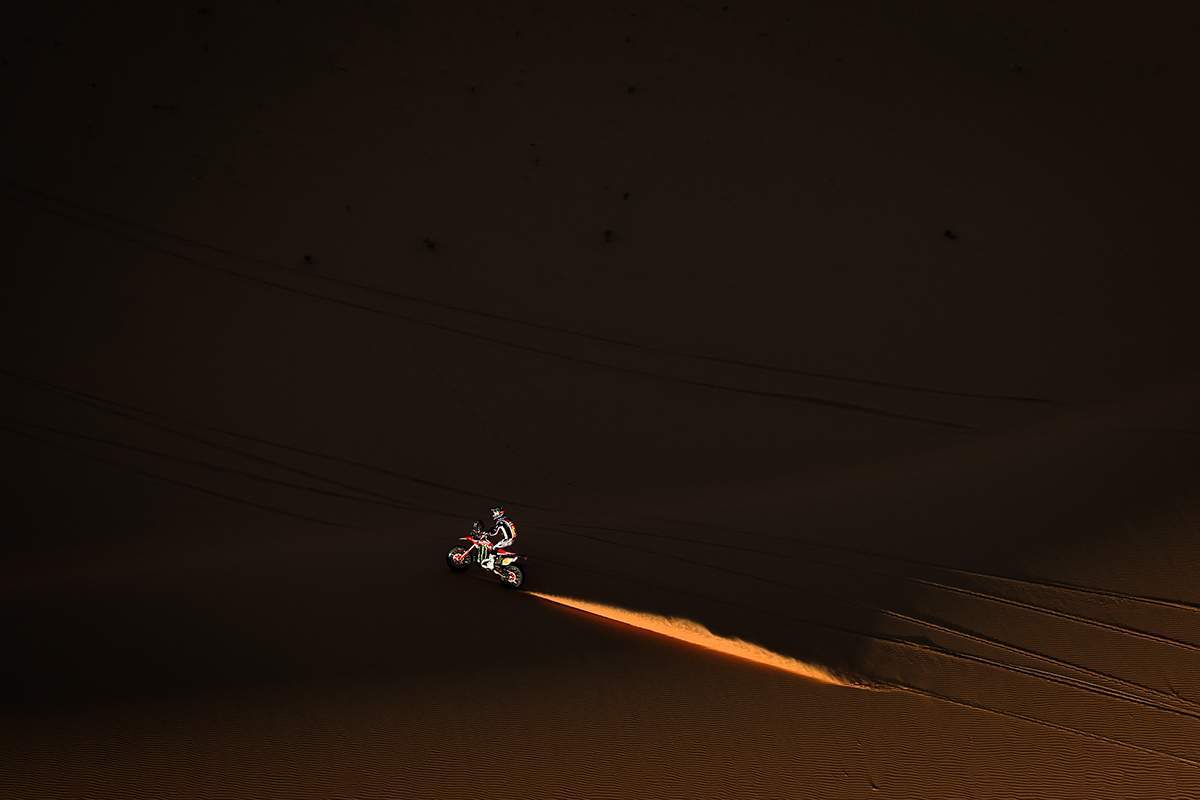
A motorcycle competitor crosses a dark desert section during Dakar 2026. The archive image belongs to the previous edition, before the rally’s move to Portugal and Morocco.Photograph: A.S.O.
The route includes six bivouacs, a detail with consequences for both preparation and recovery. A bivouac is a temporary working base, where crews arrive with the vehicle and the team works within the time and facilities the event allows. When the rally moves again, the service operation has to move with it. Parts, tools, tyres and people all have to be in the right place. The route is therefore a test of organisation as much as navigation.
Agadir gives the field a point to pause on 17 January, after Stage 6 and before the journey towards Smara resumes. That break arrives at the midpoint of the announced competitive programme, though a rest day does not erase the first week. Teams use it to inspect wear, address damage and make scheduled changes. The crew can discuss what the route has demanded so far and prepare for the section still to come.
For viewers, the rest day also creates a natural moment to take stock. The first half will establish who has kept time loss under control and whose campaign has required recovery. The second half then becomes a different contest, shaped by the order, the remaining distance and the state of each vehicle. A standings table will tell one part of that story. The route from Agadir south and then back north supplies the setting for the next part.
Agadir divides the rally into two demanding halves
Stage 6 is scheduled for 16 January. The rest day follows in Agadir on 17 January, before Stage 7 leaves for Smara on 18 January with a 500 kilometre special. The route then reaches a remote refuge bivouac, returns to Smara and turns north. This sequence makes the rest day a genuine dividing line between the first route block and a second week that pushes deeper into the south.
A rest day can look generous on a timetable. Inside the bivouac, it is a compressed workshop shift. Mechanics inspect suspension, wheels, brakes and the areas that have taken repeated impacts. Teams replace components that are due for service and review what the first week has taught them. Drivers and riders need to recover. Navigators have to absorb the next section. The event continues around them even when competition pauses.
The later stages take the field towards Dakhla before the route turns north along the Atlantic coast. Smara features more than once, giving the second half a loop that asks crews to adapt to a familiar place under a different stage plan. Marrakech is the finish on 23 January, but reaching it will depend on days of decisions that the overview map cannot show.
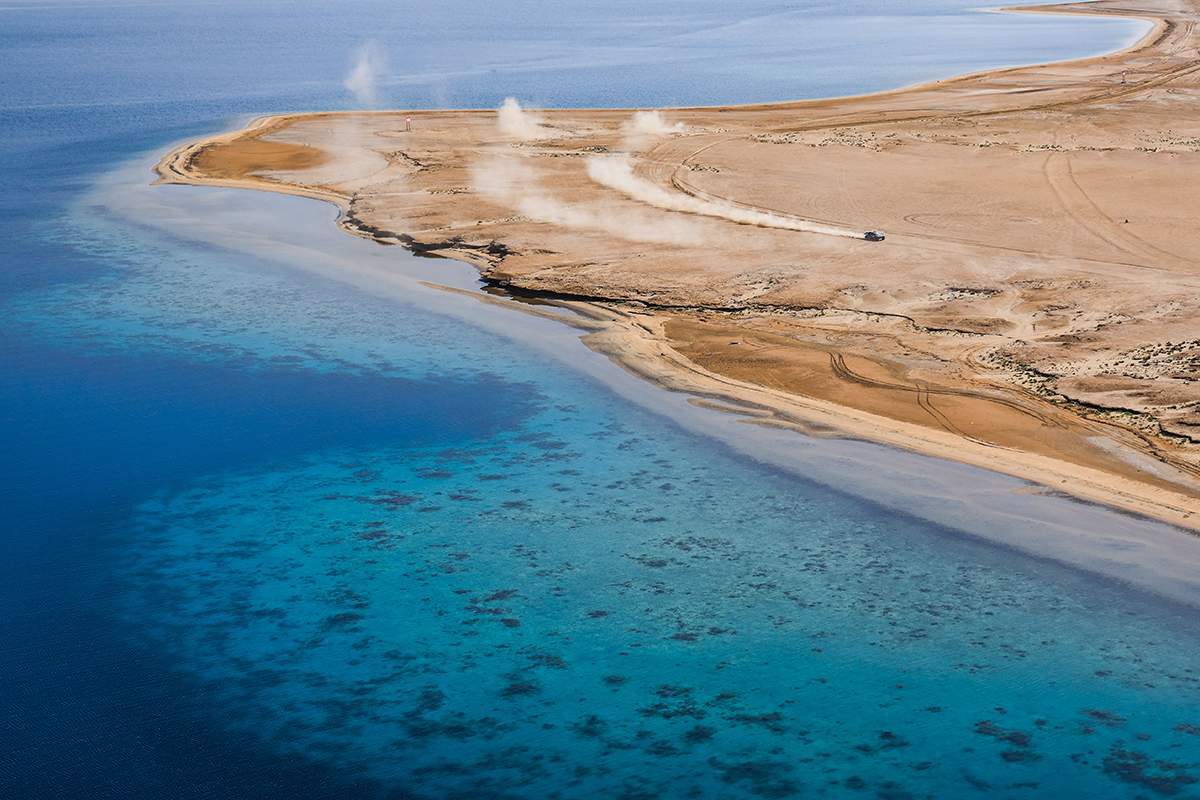
An aerial view of a competitor following the Saudi desert route beside the water during Dakar 2026. The image shows the previous edition’s setting before the 2027 move to Portugal and Morocco.Photograph: A.S.O.
The biggest day arrives close to the finish
Stage 11, from Smara to Marrakech on 22 January, is the largest total day in the published schedule at 1,035 kilometres. The special is 455 kilometres. The final stage begins and ends in Marrakech, with a 22 kilometre special inside a 240 kilometre day. Its timed distance is short by Dakar standards, though the crews will arrive carrying the effects of the route that came before it.
A short final special can still be a difficult one. Riders and drivers must arrive with the vehicle intact and enough concentration to complete the event cleanly. Mechanics prepare for the finish while team managers continue to monitor the classification and the limits of what each vehicle can safely do. Dakar’s last day is a finish line and a final responsibility.
The route announcement is therefore a planning document as much as a destination list. It gives teams the broad geography, total distance and sequence of major locations. The road book will add the navigational detail, and subsequent event information will refine the logistics. The first useful decision for a team is to understand how the pieces fit together, then decide where to spend its limited time and resources.
A return to Africa with familiar Dakar demands
Portugal and Morocco bring different motorsport histories to the event. Portugal has hosted international rally-raid competition through the Rally-Raid Portugal. Morocco’s Rallye du Maroc has been a fixture of the discipline, and the country has appeared in earlier Dakar routes. The 2027 edition connects those experiences in a format that asks teams to cross a national border and a sea before the main desert work begins.
For the people who compete, geography becomes a practical question. Where can the team test? Which parts need to travel to the opening bivouac? How should the vehicle be prepared for the changes between the Algarve and Moroccan terrain? Those questions will be answered gradually. A route announcement starts the process. It cannot replace the experience of seeing the road book or reaching the first stage.
The Dakar’s new horizon is clear enough to excite and specific enough to plan. The event is scheduled to leave Loulé and Faro, cross to Nador, travel south through Morocco, rest in Agadir and finish in Marrakech. The route totals 7,824 kilometres with 4,341 competitive kilometres. The calendar is awaiting formal approval. Teams can begin the work of making those numbers real.
The route announcement is a starting point for preparation
A route at this stage of the calendar is both a promise and a framework. Competitors know the broad movement from the Algarve to Marrakech, the key bivouac locations and the distance they will be asked to cover. The road book will carry more precise navigation. Later bulletins may refine operational details. Teams can begin planning with the official outline while leaving room for information that has not yet been published.
The international transfer from Portugal to Morocco adds a logistical layer that a Saudi-based Dakar did not require. Vehicles and personnel have to cross between countries as part of the event’s structure. The schedule identifies the sea crossing to Nador before the first Moroccan bivouac at Bouarfa. The organiser’s timetable shows that the rally is designed around that transition, placing it early enough for the field to settle into the main Moroccan route.
Six bivouacs give the event a sequence of temporary bases that move with the rally. A team’s operational plan has to follow the route, with enough equipment to address routine wear and the unexpected problems that emerge over long specials. Every kilometre contributes to the burden, whether it is timed competition or a transfer between locations. The published total distance of 7,824 kilometres gives a sense of that workload before the finer detail arrives.
The 2027 edition is scheduled to run from 9 to 23 January, subject to FIA World Motor Sport Council approval. Its return to Africa comes ahead of the planned Saudi Arabian route in 2028. That context makes this a transition year in the modern Dakar calendar. Portugal and Morocco are established rally-raid territories, though the exact challenge will depend on the stages the organisers set and the conditions crews encounter.
For followers, the most useful way to read the route is to keep the calendar, geography and distance together. The Algarve supplies the start, Bouarfa marks the first Moroccan base, Agadir provides the rest day and Marrakech hosts the finish. Between them sit 12 stages and 4,341 kilometres of timed competition. Those fixed points make the announcement legible while the exact stage character remains something to be learned through the road book and later event notes.
Comments0
Join the ViPeople conversationSign in with Google to comment, like and save stories.Continue with Google